
Being diagnosed with Type 1 Diabetes can feel overwhelming, whether you’re a parent of a child recently diagnosed or managing it yourself. While Type 1 diabetes requires lifelong care, advancements in treatments—especially here in modern medical hubs like Jumeirah, UAE—have made living with the condition far more manageable.
In this blog, we’ll walk you through both time-tested and new treatments, explore major breakthroughs, and answer common questions about managing Type 1 diabetes safely and confidently.
New Type 1 Diabetes Treatments
Science is moving fast, and new treatments for Type 1 diabetes are changing the way patients live their lives. While insulin remains the core treatment, newer therapies aim to reduce dependency on daily injections and improve long-term outcomes.
Some of the promising treatments include:
-
Artificial Pancreas (Closed-loop systems): These devices combine continuous glucose monitors (CGMs) with insulin pumps that automatically adjust insulin levels in real time. This technology is already approved in the UAE and available in top clinics like those in Jumeirah.
-
Teplizumab (Tzield): A newly approved immunotherapy drug that can delay the onset of Type 1 diabetes in people at high risk. It’s not yet widespread in the UAE but is expected to be available soon.
-
Beta-cell regeneration research: Scientists are working on therapies to restore insulin-producing cells using stem cell technology. While still in clinical trials, this could be the future of diabetes care.
These advancements bring hope and improved quality of life for patients, particularly children and young adults.
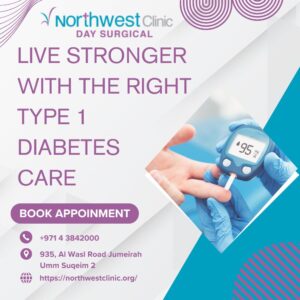
Basic Treatments for Type 1 and Type 2 Diabetes
Though Type 1 and Type 2 diabetes differ in causes and progression, their treatment strategies share some similarities. The basics include:
-
Insulin therapy: Essential for Type 1 and sometimes needed for advanced Type 2.
-
Healthy diet: Balanced meals with controlled carbs and sugar.
-
Exercise: Regular physical activity to regulate blood sugar.
-
Blood sugar monitoring: Using a glucometer or CGM.
-
Foot and eye care: Preventing complications from long-term high blood sugar.
However, the key difference is that Type 1 diabetes patients must rely on insulin from the beginning, as their bodies produce little or no insulin at all.
What Are Common Treatments for Type 1 Diabetes?
Here in Jumeirah, where access to modern clinics like Northwest Clinic Day Surgical is readily available, most patients follow a structured plan guided by an endocrinologist or diabetes specialist. The most common treatments for Type 1 include:
-
Rapid-acting insulin injections (before meals)
-
Long-acting basal insulin (once or twice daily)
-
Insulin pumps for precise and continuous delivery
-
Continuous glucose monitors (CGMs) to track real-time sugar levels
-
Low-carb, high-fiber diet plans
-
Education and self-management programs
Managing Type 1 is not just about insulin—it’s about empowering the patient and family with knowledge, tools, and support.
Type 1 Diabetes Treatment Breakthrough
One of the most exciting breakthroughs in recent years is the development of immune-based therapies that aim to preserve the body’s insulin-producing beta cells.
The Tzield (Teplizumab) drug, for instance, is the first of its kind approved to delay Type 1 diabetes in people who are in the early stages but haven’t yet shown full symptoms. This treatment could extend the “honeymoon phase” where the pancreas still makes some insulin.
Other exciting research includes:
-
Stem cell transplants that regenerate insulin-producing cells
-
Gene editing (CRISPR) approaches for long-term correction
-
Smart insulin that activates only when blood sugar is high
Although most of these aren’t fully available in the UAE yet, clinical trials and research partnerships are bringing the UAE healthcare system closer to global innovations.
Type 1 Diabetes Treatment Before Insulin
Before insulin was discovered in 1921, treatment for Type 1 diabetes was extremely limited. Doctors often prescribed:
-
Very low-carb, high-fat diets
-
Caloric restriction
-
Exercise and herbal remedies
These strategies were rarely effective in the long term. Many patients, sadly, did not survive past a few months or years. The discovery of insulin revolutionized diabetes care and remains one of the most important medical breakthroughs in history.
Today, the UAE’s modern healthcare system and the presence of leading endocrinologists ensure that patients receive timely diagnosis and insulin therapy from the start.
Type 1 Diabetes: Treating High Blood Sugar
Managing high blood sugar (hyperglycemia) is a daily reality for people with Type 1 diabetes. Symptoms may include extreme thirst, fatigue, frequent urination, and blurred vision.
Here’s how high blood sugar is typically managed:
-
Insulin correction doses: Fast-acting insulin is given based on blood sugar levels.
-
Hydration: Drinking water helps flush excess glucose.
-
Exercise (with caution): Light activity can reduce glucose, but not if ketones are present.
-
Ketone testing: Especially important if blood sugar is above 250 mg/dL.
In Jumeirah, many clinics offer real-time glucose monitoring systems and 24/7 diabetes care teams to help manage such episodes safely.
If high blood sugar becomes persistent or extreme (above 300 mg/dL), it can lead to a serious condition called diabetic ketoacidosis (DKA), requiring emergency medical care.
Living with Type 1 diabetes today is very different than it was even a decade ago. Thanks to groundbreaking research, improved technology, and access to expert care here in Jumeirah, patients can lead full, active, and joyful lives.
Whether you’re managing your own condition or caring for a loved one, remember: You are not alone. At Northwest Clinic Day Surgical, we provide personalized diabetes care plans, access to cutting-edge tools, and compassionate support every step of the way.
If you’re looking for diabetes care in Jumeirah, our team is ready to help you navigate your treatment journey with confidence.
Frequently Ask Questions
Q1: What is the most effective treatment for Type 1 diabetes?
The most effective treatment for Type 1 diabetes is insulin therapy, which replaces the insulin your body no longer produces. This includes multiple daily injections or using an insulin pump, often paired with a continuous glucose monitor (CGM) for optimal control.
Q2: What is the diabetes medication in Dubai?
In Dubai, medications for Type 1 diabetes primarily include various types of insulin (rapid-acting, long-acting, mixed). For Type 2 diabetes, medications like Metformin, SGLT2 inhibitors, and GLP-1 receptor agonists are commonly prescribed. These are available in major hospitals, pharmacies, and clinics across Jumeirah and the UAE.
Q3: Is there a surgery for Type 1 diabetes?
Currently, there’s no routine surgical cure for Type 1 diabetes. However, pancreas or islet cell transplants are performed in select cases, usually for those with severe complications or hypoglycemia unawareness. These procedures are still rare and not widely available in the UAE.
Q4: What is the new treatment for Type 1 diabetes?
New treatments for Type 1 diabetes include artificial pancreas systems, Teplizumab (Tzield) which can delay onset in at-risk individuals, and stem cell therapies under clinical trial. These cutting-edge therapies aim to reduce insulin dependence and preserve pancreatic function.
Q5: Can your pancreas start working again with Type 1 diabetes?
In most cases, the pancreas does not naturally start producing insulin again in Type 1 diabetes, as the autoimmune damage is permanent. However, early interventions and new research, such as beta cell regeneration and immunotherapy, are showing promise in preserving or partially restoring function in early stages.